






Electrical skills gap deepens as apprenticeship starts fall despite surging demand
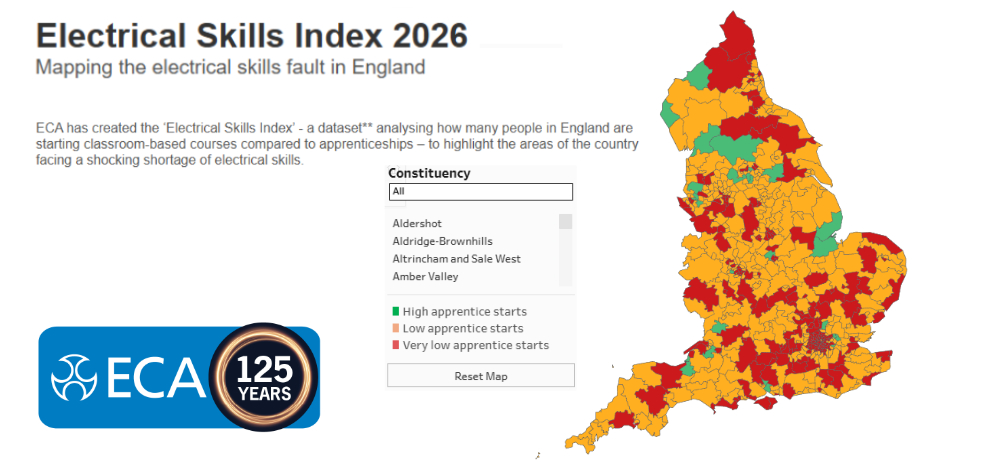
New analysis from ECA (Electrical Contractors’ Association) shows the electrical skills gap is growing nationwide, with a 5.5% drop in electrical apprenticeship starts, putting government ambitions and economic growth at risk.
The UK’s electrical skills gap is widening, across the country, at the very moment demand for skilled electricians is accelerating, according to new analysis published by ECA, putting Government ambitions and targets at risk.
ECA’s 2026 Electrical Skills Index - which compares the number of people starting government-funded classroom-based electrical courses with those entering apprenticeships - shows that while interest in electrical careers continues to grow, the system is failing to convert that interest into qualified electricians. Fewer than 1 in 5 learners enrolled in government-funded, classroom-based electrical courses progressed into an apprenticeship or skilled employment over 2025/26.
ECA is calling on the Government to work with industry to tackle the growing national shortage of qualified electricians. ECA’s newly published 'Electrical Skills Index' - a dataset analysing how many people in England are starting classroom-based courses compared to apprenticeships - reveals a deepening structural imbalance across the skills system.
Key findings from the ECA 2026 Electrical Skills Index:
More than 26,000 learners enrolled in government-funded, classroom-based electrical courses in 2024/25 — up significantly from previous years — yet available outcomes data continues to indicate that less than 1 in 5 progressed into an electrical apprenticeship or skilled employment within 12 months.
Over the past year. electrical apprenticeship starts have fallen by 5.5%, even as apprenticeship starts overall rose by 4.1%, and as the electrification programmes gather pace across the country.
For the second Skills Index in a row, a number of economic heartlands face the highest electrical skills shortages, with regions such as Greater London, North West, and West Midlands the most affected.
The East Midlands, South West, South East and Greater London saw an average 8% fall in electrical apprenticeships starts last year compared to 2022/23. These same regions saw an average of a 16% increase in government-funded course enrolments last year compared to 2022/23
Skills England estimates the UK will need an additional 12,000 electricians by 2030, yet data shows work-based routes into the industry are shrinking. With around 90% of learners still unable to secure a foothold in the profession, Government ambitions on growth, employment and net zero are increasingly at risk.
Luke Cook, ECA Skills Deputy Chair commented: “The electrical skills gap is no longer a future risk, it is a live and growing threat to the delivery of electrification. Demand for electricians is surging, but the number of people entering the industry through apprenticeships is going backwards.”
Andrew Eldred, Deputy Chief Executive Officer at ECA says: “In ECA’s 125-year history, we have never seen a gap so wide between ambition and workforce reality. We are training more people but producing fewer qualified electricians, at the exact moment the country needs them most.
Without urgent, targeted support for the SMEs that train and employ the workforce, Clean Power 2030 and economic growth will simply not be deliverable. Employers cannot fix this alone. If the system does not change, the skills gap will continue to widen and delivery will fall further behind.”
The Index shows that while training provision and learner interest are strong, the system is increasingly failing at the point of employment. SMEs, which train and employ the majority of new entrants, are finding it harder to take on apprentices due to rising costs and risk. Without addressing this, the skills system will continue to struggle to convert training into qualified electricians.
Andy Hawes, CEO of ECA member 24-7 Group, commented: “We believe apprenticeships are the foundation of a resilient and future-ready electrical sector. They equip new entrants with the practical skills and safety-critical knowledge the industry depends on, while giving employers a reliable pipeline of talent. However, the reality is that high training costs, regulatory demands, and the time needed for quality supervision remain real barriers for many businesses. Addressing these challenges collaboratively is essential if we are to close the skills gap and power the UK’s transition to a net-zero economy
We have seen this impact first-hand. One of our recent electrical apprentices joined us with strong motivation but limited site experience. Within months, through structured training and mentoring, they were contributing confidently on live projects, improving productivity for our teams and gaining nationally recognised qualifications. Today, they are progressing rapidly within the business — proof that when apprenticeships are done well, they create lasting value for both individuals and employers."
ECA is calling for a focused, employer-led approach to fixing the electrical skills system. Without this shift, rising participation in training will continue to fail at the point of employment, leaving too many learners unable to access apprenticeships or progress into qualified work.
To fix the growing electrical skills crisis, ECA recommends:
- Rebalance funding towards employment outcomes
- Put employers at the centre of the system
- Reduce costs to SMEs
- Strengthen support for apprenticeship delivery
- Align national and regional policymaking
ECA is supporting its Members as skills policy shifts to regional authorities. In the past year, five Electrotechnical Training and Careers Alliances (ETCAs) have been established in Greater Manchester, the West Midlands, Cheshire & Warrington, Cambridgeshire & Peterborough, and Kent & Medway. The ETCAs brings ECA Members, training providers and regional bodies together to tackle local skills gaps. Two further Alliances, in South Yorkshire and the North East, will launch during National Apprenticeship Week in February 2026, with more to follow.
This article appears on the ECA news and blog site as "Electrical skills gap deepens as apprenticeship starts fall despite surging demand" dated 9 February 2026.
--ECA
[edit] Related articles on Designing Buildings
- ECA articles.
- ECA launches Welsh Election Manifesto..
- ECA welcomes Government’s Clean Energy Jobs Plan.
- Energy security.
- Net zero.
- Renewable energy.
- Skills gap.
- Skills.
- Skills England assessment published as ECA Skills Committee appoints new Deputy Chair.
- Skills shortage.
- Skilled workforce unable to meet net zero ambitions.
- Skills shortage.
- Solar energy workforce goals and the ECA Charter to recharge electrical skills.
- Solar panels, pitched roofs and risk of fire spread .
- Warm Homes Plan Workforce Taskforce..
- Welsh Skills Body (Medr) launches ambitious plan.
- Wired for growth: How electricians can close the skills gap.
- Workforce planning to deliver clean secure energy: DESNZ report.
Featured articles
Check out some of the best features and news from Designing Buildings as well as key stories from around the web.

Sir Edwin Lutyens: Britain's greatest architect? Book review.

CIOB publishes free template to help assess and manage risks.
ECA's reflections on Party Conference season

Burnham wants to be confident of winning before asking for a fresh mandate.
New Chief Construction and Scientific Adviser

Sergio Cavalaro, Professor of Infrastructure Systems at Loughborough University.
Building safety levy for England

CIAT publish estimator tool for members.

Water sector faces a growing crisis that could slow the delivery of vital infrastructure.
Undervaluing our industrial past

Heritage value changes as taste for building styles changes.
Changing expectations around competence and compliance

New information sheet from CIAT.
Grenfell investigation files passed to CPS

Angela Rayner apologises on behalf of the British state.

Electrical contractors need to understand the practical implications.

The real barrier to getting more value from digital technology.

Your guide to The Construction Reset at UKCW Birmingham.